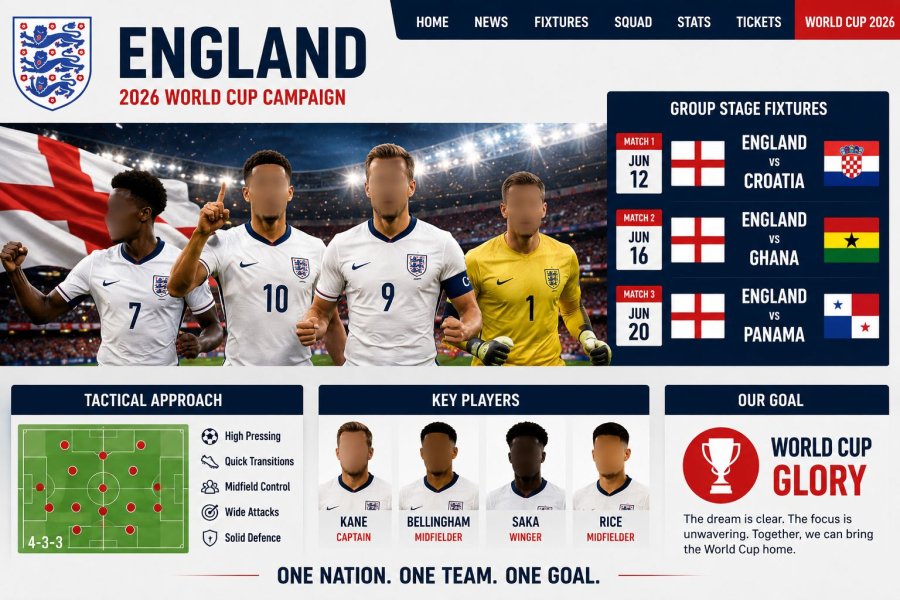
If you are looking ahead to an England vs Croatia FIFA World Cup group-stage clash on Wednesday 17 June 2026, the headline takeaway is simple: England have the tools to control the match, create higher-quality chances, and turn small advantages into a result.
One important note for accuracy: match schedules, group allocations, and kickoff details can change as tournaments approach. So, rather than treating any single date as guaranteed, this is best read as a matchup-focused preview explaining why England’s underlying strengths make them a strong bet to come out on top if and when this fixture happens in the group stage.
Why this matchup matters in a World Cup group
Group games at a World Cup are where momentum is built. A strong performance:
- puts early points on the board, reducing pressure in later matches,
- improves goal difference, which can decide qualification,
- boosts confidence and cohesion, especially for newer combinations,
- lets a team manage minutes across a packed tournament schedule.
England’s profile in recent tournaments suggests they understand that rhythm: start well, stay compact, and let their attacking quality decide the game.
The core case for an England win
England’s advantage is not just one star player or one tactical trick. It is the combination of depth, pace, structured possession, and set-piece threat that gives them multiple ways to win the same match.
Against Croatia specifically, that “multiple routes to victory” matters, because Croatia are traditionally excellent at slowing games down, managing tempo, and dragging opponents into long spells of patient probing.
Key strengths that tilt the game toward England
1) Tournament-tested structure (without losing attacking ambition)
England have, over multiple major tournaments, shown a consistent ability to blend:
- defensive control (limiting transitions and high-value shots), with
- attacking efficiency (creating chances through wide play, central combinations, and dead balls).
That matters in group games, where opponents often prioritize risk management. England’s ability to stay patient while still generating chances is a major edge.
2) Depth across the pitch (fresh legs, flexible plans)
World Cup group stages reward squads that can rotate without a big drop in quality. England are typically strongest when they can adjust between:
- a possession-heavy approach to control tempo,
- a faster, transition-based plan to punish turnovers,
- game-state management if they score first.
This depth is not just about replacing one player; it is about changing the shape and rhythm of the match. If Croatia settle into a comfortable pattern, England have the personnel to switch the picture.
3) Pace and 1v1 ability in wide areas
Against Croatia, one of the most productive ways to generate chances is to stretch the field and force uncomfortable defending in the channels. England’s usual advantage here is:
- quick wide players who can win 1v1s,
- overlaps and underlaps that create cutback lanes,
- the ability to attack the far post with runners.
When England move the ball quickly from side to side, Croatia’s compact block is asked to shift repeatedly. Over 90 minutes, that tends to create the kind of half-second of space that leads to a clear shot or a decisive final pass.
4) Midfield control through physicality and passing variety
Croatia’s identity has long been tied to midfield intelligence: retaining the ball, choosing the right moments to accelerate, and taking the sting out of opponents. England’s pathway to winning this chess match is to combine:
- athletic ball-winning to disrupt build-up, with
- progressive passing to quickly turn regains into attacks.
In practical terms, England can win by forcing Croatia to defend more than they want to, and by preventing Croatia from building long, calming possession sequences.
5) Set pieces as a reliable scoring channel
In tight World Cup games, set pieces often decide outcomes. England have been widely recognized in recent years for treating dead balls as a repeatable, rehearsed advantage. The benefits are huge:
- you can score even when open play is cagey,
- you can punish fouls and corners that are otherwise “safe,”
- you can shift momentum with one delivery and one header.
Against a disciplined opponent like Croatia, having a strong set-piece plan is not a bonus; it is a practical route to victory.
What England’s winning game plan can look like
England do not need a single perfect script to win. They need a plan that holds up across game states. Here is a realistic, advantage-driven blueprint.
Phase A: Start with control, not chaos
- Keep Croatia facing their own goal by circulating the ball quickly and switching play.
- Press selectively, targeting predictable passes into midfield.
- Avoid needless turnovers that give Croatia calm possession and time to reset.
Phase B: Create high-quality chances through width and cutbacks
- Attack the half-spaces to pull Croatian midfielders out of their comfort zone.
- Use wide overloads to reach the byline and look for cutbacks, which are among the highest-value chance types in modern football.
- Commit runners into the box in timed waves rather than constant flooding, maintaining protection against counters.
Phase C: If England score first, make Croatia chase
- Reduce Croatia’s ability to manage tempo by forcing them to take more risks.
- Exploit the spaces that appear as Croatia push full-backs and midfielders forward.
- Turn transitional moments into shots, corners, and set pieces.
This is where England’s depth and athleticism can be decisive: a one-goal lead can quickly become two if Croatia are forced into a more open game than they prefer.
The key battles that can decide the match
Big tournament games often come down to a handful of micro-duels. In this matchup, England’s path to victory becomes clearer when these battles tilt their way.
- England’s wide attackers vs Croatia’s full-backs: winning 1v1s and generating cutbacks is a direct chance-creation engine.
- England’s midfield disruptors vs Croatia’s tempo-setters: interrupting Croatia’s rhythm prevents them from “cooling” the game.
- Second balls after crosses and set pieces: sustained pressure often comes from winning loose balls at the edge of the box.
- Transition defense: England’s rest defense (how they are positioned to stop counters) protects them from Croatia’s smartest breaks.
Why England’s recent tournament profile supports optimism
England have compiled meaningful experience in the latter stages of major tournaments in recent years, including a World Cup semi-final run in 2018 and a European Championship final appearance in 2020. Those experiences matter in group games because they help teams:
- stay calm when a match is level late on,
- avoid overcommitting when patience is required,
- execute set pieces and defensive details under pressure.
In other words, England’s confidence is not just hype. It is grounded in a body of high-stakes matches where marginal gains and game management made the difference.
A quick snapshot: England’s win factors at a glance
| Factor | What it means in this match | Why it helps England win |
|---|---|---|
| Depth | Options to rotate or change the game from the bench | Maintains intensity over 90 minutes and across the group stage |
| Width and pace | Stretching Croatia’s compact shape | Creates cutbacks, corners, and defensive mistakes |
| Midfield disruption | Stopping Croatia from dictating tempo | Turns the match into England’s preferred rhythm |
| Set pieces | High-leverage moments from corners and free kicks | Provides a reliable scoring path in tight games |
| Game management | Protecting leads and avoiding wild transitions | Converts advantages into points, not just possession |
So, will England win?
No preview can honestly guarantee a result, especially for a match that sits in the future and may have evolving squad dynamics, form, and even scheduling details. What a preview can do is clarify probabilities based on repeatable football factors.
From that perspective, England have a persuasive, practical case: they can hurt Croatia in multiple ways, they can stay stable if the game becomes tense, and they have the tournament-tested habits that win group matches.
If England execute their plan with discipline, the most likely story is a controlled performance, sustained pressure through wide areas, and at least one decisive moment from either a cutback sequence or a set piece. That combination is exactly how strong World Cup teams turn quality into three points.
What an England win delivers in the bigger World Cup picture
Beyond the satisfaction of beating a respected opponent, a win over Croatia in the group stage can deliver tangible tournament benefits:
- Control of the group narrative: England can dictate what they need from later matches.
- Squad management advantages: more freedom to rotate while protecting key players.
- Confidence that travels: a strong performance tends to sharpen decision-making in knockout football.
That is why this game, on a date like Wednesday 17 June 2026 if it lands there, feels bigger than just 90 minutes. For England, it is an opportunity to pair performance with points, and to set a tone that says they are not just participants in 2026, but true contenders.
