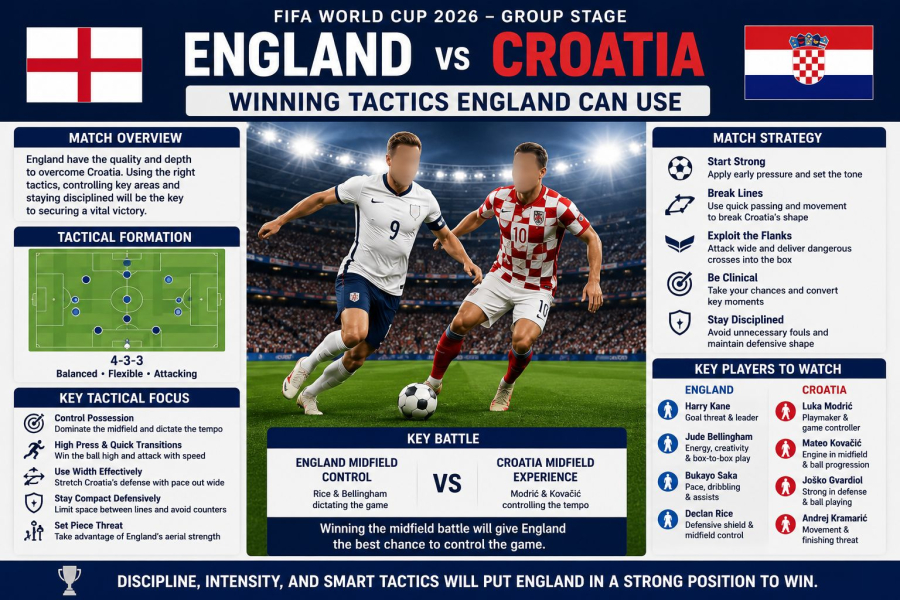
England vs Croatia has become a modern heavyweight matchup: technically secure midfield play, patient build-up, and moments of ruthlessness in transition. If these teams meet at the FIFA World Cup 2026, England’s best path to victory is likely to come from clear game-state planning: control Croatia’s rhythm, create high-quality chances through structured wide and half-space patterns, and turn dead-ball situations into a consistent scoring edge.
Because squads and form can change between cycles, the ideas below are framed as a tactical playbook rather than a prediction of exact lineups. The core theme is simple: England can win by combining athletic intensity with calm, repeatable attacking patterns.
Start with the “why”: what typically makes Croatia difficult to beat
Croatia’s best versions are usually defined by three strengths that England should plan for:
- Midfield composure under pressure that helps them escape the first press and dictate tempo.
- Possession with purpose, using central rotations to open passing lanes into the half-spaces.
- Game management that slows matches, reduces chaos, and squeezes opponents’ shot quality.
The upside for England is that these strengths also reveal where Croatia can be stressed: disrupt the first pass, force play wide, and attack the spaces that appear when Croatia’s fullbacks step forward.
England’s high-level game plan: intensity with structure
England’s most persuasive route to a win is a plan that is both aggressive (to prevent Croatia settling into a rhythm) and structured (to avoid being played through). That means:
- Press with clear triggers, not constant chasing.
- Control central zones with a compact midfield shape.
- Attack through wide overloads and half-space runs, not hopeful crosses.
- Build a strong set-piece advantage to break tight game states.
When these pieces connect, England can turn the match into a sequence of repeatable winning moments: forced turnovers, fast entries into the box, and set-piece pressure that compounds over 90 minutes.
Out of possession: a press that targets Croatia’s first build-up pass
1) Use a “split press” to force play wide
Instead of pressing everywhere, England can press in a way that protects the middle first and invites passes into less dangerous areas. A common approach is to angle the first line of pressure to block central access, then attack the receiver near the touchline.
Desired outcome: Croatia are pushed toward the flanks, where their options shrink and England can trap with the touchline as an extra defender.
2) Pressing triggers: make the press predictable for England, not for Croatia
Pressing works best when it is triggered by moments of reduced control. England can look to jump aggressively on:
- Back passes to the goalkeeper or centre-backs.
- Square passes across the defensive line.
- Receiving on the “wrong” foot (body shape closed toward the field).
- Slow first touches by the pivot or fullback.
This approach delivers two benefits: it raises the chance of creating a high turnover, and it reduces the risk of England being played through because the press is launched from stable positions.
3) Protect the “Zone 14” pocket (top of the box)
Croatia’s most dangerous possession sequences often involve feeding the central pocket just outside the penalty area, where shots and through balls become high value. England’s midfield and centre-backs can prioritise compactness here by:
- Keeping the double pivot (or single pivot plus an 8 dropping) within close passing distance.
- Passing runners on quickly to prevent drawn-out 1v1 defending.
- Allowing low-risk wide circulation while blocking central progression.
Benefit: Croatia may still have the ball, but England control what the ball can actually do.
In possession: build attacks that generate cutbacks, not just crosses
1) Create a consistent “free player” with a box midfield
A highly effective modern structure is the box midfield (often seen as a 3-2 or 2-3 in build-up, forming a square of four central options). The objective is to always have one midfielder who can receive facing forward.
Against Croatia’s compact midfield, this is valuable because it helps England progress without relying on risky vertical passes.
- Two deeper players provide stability and safe circulation.
- Two higher central players occupy Croatian midfielders and create receiving angles.
Positive outcome: England maintain control and can choose the moment to accelerate, rather than being forced into low-percentage play.
2) Attack the half-spaces with third-man runs
Croatia’s block can be hardest to break with simple dribbles. A more reliable method is using third-man combinations: pass into a checking player, then play quickly into a runner who arrives at speed.
England can target the channels between Croatia’s fullback and centre-back (the half-spaces) because:
- They create higher-quality shooting angles than wide areas.
- They open lanes for cutbacks, which are among the most efficient chance types in top-level football.
3) Wide overloads with an underlap option
England can be especially persuasive when their wide play is not one-dimensional. The goal is to create a 2v1 or 3v2 on a flank, then vary the final action:
- Overlap to cross when the defender is pinned.
- Underlap to enter the box and cut back.
- Switch to the far side if Croatia collapse.
This is benefit-driven football: the overload forces a defensive decision, and the variation punishes whichever decision Croatia makes.
Transitions: win the “five-second game” after turnovers
1) Counter-press to keep Croatia from resetting
One of the biggest advantages England can build is a strong counter-press (immediate pressure after losing the ball). Against Croatia, this matters because it prevents them from calmly finding midfield outlets and slowing the match.
Key principle: counter-press with nearby numbers, while the deeper players maintain a rest defense structure behind the ball.
2) Direct counters into the space behind advancing fullbacks
When Croatia’s fullbacks push up, the space behind them can become a launchpad for England. The highest-upside counters usually look like:
- First pass forward into a runner or into the striker’s feet.
- Second action into the channel for a wide attacker or overlapping fullback.
- Final action as a cutback or a square pass across the six-yard area.
Benefit: England can create chances before Croatia’s midfield shape reforms, turning athleticism and speed into tangible shot quality.
Set pieces: a realistic, repeatable advantage in tournament football
In knockout-style matches and tight group games alike, set pieces can decide outcomes even when open play is balanced. England can treat set pieces as a deliberate scoring stream, not a bonus.
What England can do well on attacking set pieces
- Vary delivery: inswingers, outswingers, and flat balls to the penalty spot to prevent predictable defending.
- Use screens legally: coordinated movement that blocks runs without fouling.
- Attack zones, not just men: assign runners to the six-yard line, penalty spot, and far-post corridor.
- Plan second balls: station players for rebounds and cutback crosses after clearances.
Positive outcome: even if Croatia defend the first phase, England sustain pressure and increase the probability of a decisive moment.
Game-state management: how England can stay in control for 90 minutes
1) If England score first: tighten the centre, keep the threat
After taking a lead, the temptation is to drop too deep and simply survive. A more productive approach is to:
- Defend with compact lines to deny central access.
- Keep at least two outlets high enough to threaten counters.
- Use controlled possession phases to drain momentum without losing attacking intent.
This helps England protect the lead while still looking like the team most likely to score next.
2) If the match is level late: increase chance quality, not just volume
Late in close games, low-quality shots can actually help the opponent by handing over possession. England can stay efficient by prioritising:
- Box entries over long-range attempts.
- Cutbacks over contested aerial balls.
- Set-piece pressure by winning corners and free kicks in wide areas.
3) Smart substitutions: change the picture, keep the structure
England’s depth is often a tournament advantage. Substitutions can be used tactically to introduce:
- Fresh pressing legs to re-energise the counter-press.
- A direct runner to attack space behind the back line.
- An extra midfielder to protect central zones if Croatia begin to overload.
The key is to preserve the team’s spacing and responsibilities so England do not lose their tactical clarity as personnel changes.
A practical tactical blueprint (summary table)
| Phase | England tactic | What it aims to win |
|---|---|---|
| Build-up | Box midfield to create a free receiver | Progression through the centre without risky passes |
| Chance creation | Half-space attacks + third-man runs | Cutbacks and high-quality shots |
| Wide play | Overloads with overlap and underlap options | Defensive confusion and decisive final balls |
| Pressing | Split press to force wide + touchline traps | Turnovers in advanced areas |
| Transitions | Counter-press with rest defense | Stop Croatia’s rhythm and launch fast attacks |
| Set pieces | Varied deliveries + planned second balls | Repeatable scoring chances in tight games |
Why this approach gives England a strong winning edge
This playbook is designed to produce the kinds of advantages that matter most in World Cup football:
- Control of central spaces, which limits Croatia’s best creative patterns.
- Higher shot quality, with cutbacks and half-space entries replacing low-percentage attempts.
- Momentum management, using pressing triggers and counter-pressing to prevent Croatia from slowing the game.
- Set-piece superiority, which can decide elite matchups even when open play is close.
Put together, these tactics position England to win not just with talent, but with a repeatable system: one that creates pressure, turns pressure into chances, and turns chances into goals.
Final takeaway
If England meet Croatia at the FIFA World Cup 2026, the most convincing route to victory is likely to be structured aggression: press with purpose, dominate the half-spaces, and make set pieces a constant threat. With disciplined spacing and a commitment to cutback-driven chance creation, England can tilt the match toward the outcomes that win tournament football: control, clarity, and decisive moments.
