In a FIFA World Cup, the first group game can set the tone for everything that follows. When the opponent is Croatia, a nation with a recent history of deep tournament runs, the importance of a strong England result rises even further. A win is the headline outcome, of course, but even the broader idea of “a good result” matters: a performance that delivers points, belief, and clarity about how England can navigate the group and build toward the knockout rounds.
World Cups are short, intense, and emotionally charged. There is limited time to recover from a slow start, and early games can shape not only the table, but also the atmosphere around a squad. Against a side like Croatia, where small margins often decide big matches, England’s opening night becomes more than just 90 minutes: it becomes an opportunity to establish momentum, reinforce identity, and put the rest of the group on notice.
The opening match is where group-stage narratives are born
The group stage is often described as a marathon of three games, but it can feel like a sprint because every point changes the picture immediately. After matchday one, the table begins to influence decision-making: risk levels, rotation, game management, and even the psychological approach to the next fixture.
For England, starting strongly against Croatia can generate a narrative of control rather than catch-up. That matters because teams that open with points can play with more composure in match two and match three, while teams that start slowly often feel compelled to chase games, take extra risks, and rely on other results.
Why Croatia amplifies the stakes
Croatia have been one of international football’s most consistent tournament performers in recent cycles, including finishing as 2018 World Cup finalists and taking third place at the 2022 World Cup. That pedigree changes the emotional weight of the occasion. England getting a good result in this matchup isn’t only about the table; it’s a statement that England can handle an opponent with proven knockout-level toughness right from the start.
Even when Croatia are in transition between generations, the qualities that define them in tournaments tend to remain familiar: calmness under pressure, strong midfield control, and comfort in close games that can swing on one moment of quality.
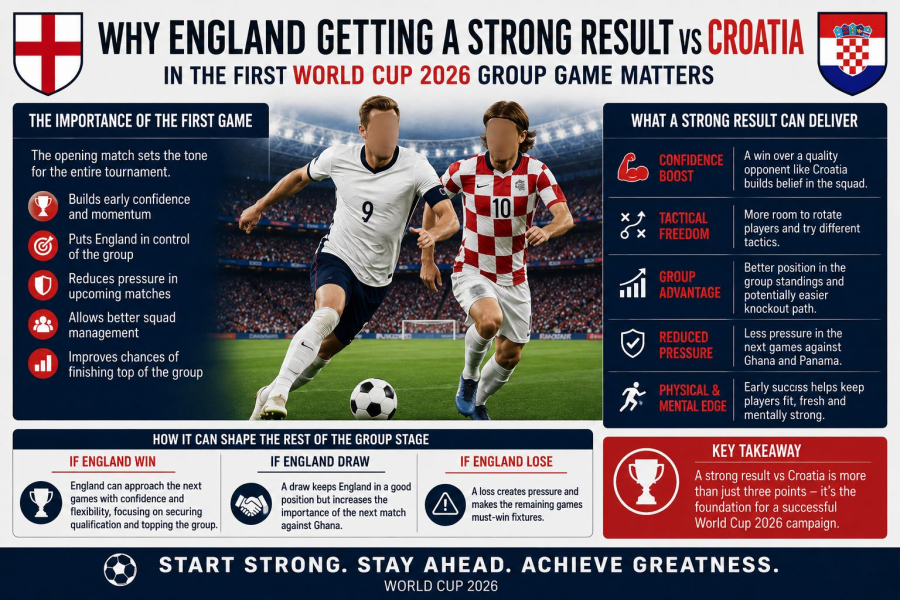
Points first: the practical benefits of an early result
World Cup group stages can be unforgiving, and the math is simple: the sooner you earn points, the more routes you open to qualification. A strong opening result against a direct contender reduces the need for “must-win” pressure later.
What a win, draw, or loss tends to change
| Opening result vs Croatia | Immediate impact | What it enables for England |
|---|---|---|
| Win | Top-of-group positioning early; Croatia forced to chase | More control over group destiny; potential to manage minutes later; boosts belief and external confidence |
| Draw | Keeps pace without falling behind; maintains balance | Pressure stays manageable; qualification remains firmly in England’s hands with strong follow-up results |
| Loss | Instant pressure; less margin for error | Increases urgency in later matches; can force tactical and selection changes under stress |
That’s why “a good result” is not just a nice-to-have. It can be the difference between playing the rest of the group stage with intention, or playing it with anxiety.
Momentum is real at tournaments (and England have benefited before)
Tournaments reward teams that build rhythm quickly. The opening game is where passing patterns, pressing triggers, set-piece roles, and in-game leadership all become real under match pressure. Getting that first positive outcome gives players proof that the plan works, and it often helps them play with greater freedom in the matches that follow.
England’s recent tournament history shows the value of early confidence
- 2018 World Cup: England opened with a late win against Tunisia, which helped create momentum in a group they ultimately topped.
- 2022 World Cup: England started with a convincing win against Iran, which set a high-performance standard and immediately put them in a strong position to progress.
The point isn’t that every early win guarantees a deep run. The point is that early success makes it easier to establish a tournament “feel”: confidence in decision-making, sharper execution, and a calmer response when setbacks arrive.
Why the first group game shapes pressure and psychology
International football is as much about emotional control as tactical control. The first match is where expectations collide with reality, and where squads either settle or tighten up. England, as one of the world’s most scrutinized national teams, can gain a huge advantage by turning their opening match into a platform rather than a test.
Three psychological benefits of starting well
- Freedom in performance: Players are more likely to play forward, take smart creative risks, and commit fully to duels when they feel the tournament is underway positively.
- Clarity in roles: A good result often confirms that the chosen structure and lineup work in real conditions, reinforcing belief across the squad.
- Resilience bank: If a tough moment arrives later (a goal conceded, an injury, a difficult quarter-final), a positive opening creates a memory of competence the team can lean on.
Against Croatia, a side comfortable in tense matches, emotional control is especially valuable. A strong opening result can reduce the risk of England feeling they must be perfect, and instead encourage them to be consistent.
Group control: how a strong start can shape tactics in matches two and three
One of the underrated advantages of an opening result is how it influences a coaching staff’s options later in the group. Points provide flexibility. Flexibility can protect player fitness, reduce injury risk, and help manage suspension concerns.
What flexibility looks like in a World Cup group stage
- Smarter squad rotation: If England start well, they are more likely to rotate selectively rather than reactively, keeping key players fresher for knockout rounds.
- Better game management: A team with points in hand can prioritize control, minimize chaos, and choose when to accelerate or slow the game.
- Less forced risk: Teams chasing qualification often push numbers forward, which can increase exposure to counterattacks and set-piece pressure.
In short: a good opening result doesn’t just add points; it can improve decision-making across the whole group stage.
Croatia’s tournament DNA makes early margins decisive
Croatia’s recent World Cup record highlights a key reality: they are often extremely hard to separate. Their games can become contests of patience, concentration, and execution in the most decisive moments. That means England’s opening approach must value both ambition and maturity.
What tends to decide games against elite tournament teams
- Set pieces: World Cup matches frequently swing on corners, free kicks, and second balls. Deliveries, runs, and defensive structure are crucial.
- Midfield control: Croatia are known for technical midfield quality; England benefiting from a strong result often starts with matching composure in central areas.
- Transitions: The ability to attack quickly without losing defensive balance can be a difference-maker, especially when the match tightens late on.
Because Croatia can be difficult to break down, England’s “good result” mindset should also include staying switched on. In tournaments, a single lapse can undo an otherwise strong performance.
Beyond the table: why a strong opener can lift the entire England campaign
England’s World Cup journey is never just about the players on the pitch. The atmosphere around the team matters: training-ground confidence, public belief, and the tone of the conversation in the wider football culture. A strong opening result can unify that environment and reduce distractions.
Four knock-on benefits that often follow a positive start
- Quieter external noise: Winning early reduces urgent debate about selections and tactics, allowing the squad to focus on recovery and preparation.
- Stronger internal competition: When the team starts well, squad players tend to push standards in training rather than feel they are trying to rescue a situation.
- Sharper identity: A good result against a high-level opponent makes it easier to commit to the chosen style of play.
- Fan energy: Support can become a positive force, helping players ride momentum and recover from inevitable tough phases.
Momentum is not magic, but it is a real competitive advantage when it encourages better decisions, clearer communication, and higher collective belief.
What “a good result” can look like in practical terms
While three points are always the target, defining “a good result” with a bit more detail helps clarify why the first match matters so much. In tournament football, success is often built from repeatable actions rather than one-off brilliance.
Ingredients of a strong England opener vs Croatia
- Start fast without losing structure: Early intent matters, but so does protecting against counters.
- Control the emotional temperature: Avoid cheap fouls, unnecessary bookings, and rushed attacking decisions.
- Create high-quality chances: Not just shots, but opportunities that reflect good positioning and smart combinations.
- Defend set pieces cleanly: Clear roles, strong first contacts, and alertness to second balls.
- Finish the game strongly: Many big international matches are decided late; fitness, subs, and focus can be decisive.
If England deliver those elements, they increase the probability of getting the outcome they want, and they also build a foundation that can travel with them through the group and into the knockouts.
Why it matters specifically for England’s broader World Cup ambitions
England have shown in recent tournaments that they can compete at the business end. They reached the 2018 World Cup semi-final, the Euro 2020 final, and the 2022 World Cup quarter-final. That track record creates an expectation: England are no longer seen as outsiders hoping for a good run; they are viewed as a side with the potential to go deep.
With that expectation comes a challenge: elite teams are judged on how efficiently they handle the group stage. A strong opening result against Croatia would signal that England are ready to approach the tournament like a top contender: professional, controlled, and capable of winning difficult games without needing everything to go perfectly.
The statement value of winning tough games early
When a team beats high-quality opposition early, it can change how future opponents approach them. In a World Cup, that can mean opponents becoming more cautious, which can create more space and control for England. It also reinforces a key internal message: England do not need to “grow into” the tournament; they can arrive ready.
Success stories: what early wins can unlock later
While every tournament is unique, a familiar pattern often holds: early wins give teams the bandwidth to refine rather than reinvent. That matters because the best World Cup sides tend to improve as they go, making small upgrades to timing, chemistry, and decision-making.
What England can build after a strong first result
- Refining attacking patterns: With points on the board, training can focus on improving chance quality and final-third combinations.
- Developing leadership: A positive start creates opportunities for leaders to cement standards and communication habits.
- Managing physical load: The group stage is physically demanding; early points can help England protect key players for knockout football.
In other words, a good opening result isn’t the destination. It’s the launchpad for the kind of steady, compounding progress that wins tournaments.
How England can sell themselves the right message before kickoff
Big opening games can create a temptation to treat the moment as a burden. But the most effective teams frame it differently: as an opportunity to earn control early and to show their level against a respected opponent.
A constructive mindset for England vs Croatia
- Play the occasion, not the fear: Use the energy of matchday one to raise intensity, not to tighten up.
- Value the point structure: Be intelligent about when to take risks and when to prioritize game control.
- Trust tournament habits: Simple, repeatable actions (defensive distances, set-piece discipline, transition balance) win World Cup points.
That approach aligns perfectly with the idea of getting a “good result”: not chasing perfection, but delivering the kind of high-level performance that produces points and belief.
Final takeaway: the first result can shape England’s entire World Cup path
England’s opening World Cup 2026 group game against Croatia carries weight for clear, practical reasons: points, positioning, and pressure. But it also matters for the intangible elements that define tournament success: confidence, rhythm, emotional control, and the sense that the campaign has a strong foundation.
A good result in match one can give England the right kind of momentum: the kind built on structure, discipline, and big-game competence. And when you start a World Cup with that mix, you don’t just improve your odds of reaching the knockout rounds. You improve your chances of arriving there as a team that believes it can go all the way.
